The “personal touch” nature of my work means that I sometimes take it very seriously. This is problem more often than you’d think — creative work benefits from a certain lightness of attitude. Clenching begets avoidance.
When I finally sit down to get something done, it involves a certain resolve and continued focus. “I am now going to sit down and think, with a very real probability that I end up with nothing to show for it” is the premise of the game. As a fallen being, my ever-frequent response is to delay getting started.
Doesn’t this suck for your clients?
Insofar as they must suffer delays and uncertain timelines, yes. In practice, it’s…alright? For things that involve deadlines, I pull myself together and get the job done. For things that don’t, my clients are forgiving people and usually more than pleased when I finally get around to doing my thing.
It’s also become less and less of a problem as I’ve become better at what I do. More confidence in my skills → the less likely a failed session seems to me → the easier it is to just do the work.
There are, of course, a multitude of tips and tricks for simply GETTING THINGS DONE, and I am well aware of most of them. However, I’ve also used them enough to know that, in the face of HOW LIFE IS, they will fail often and fail hard. It was only once I accepted this fact, and the inevitability of procrastination, that I begun to plan for it.
I now have a project in Things called Procrastinate, where I carefully curate and rank the activites I want to reach for when dilly-dallying. The 🤏 tag marks items that are really low effort.
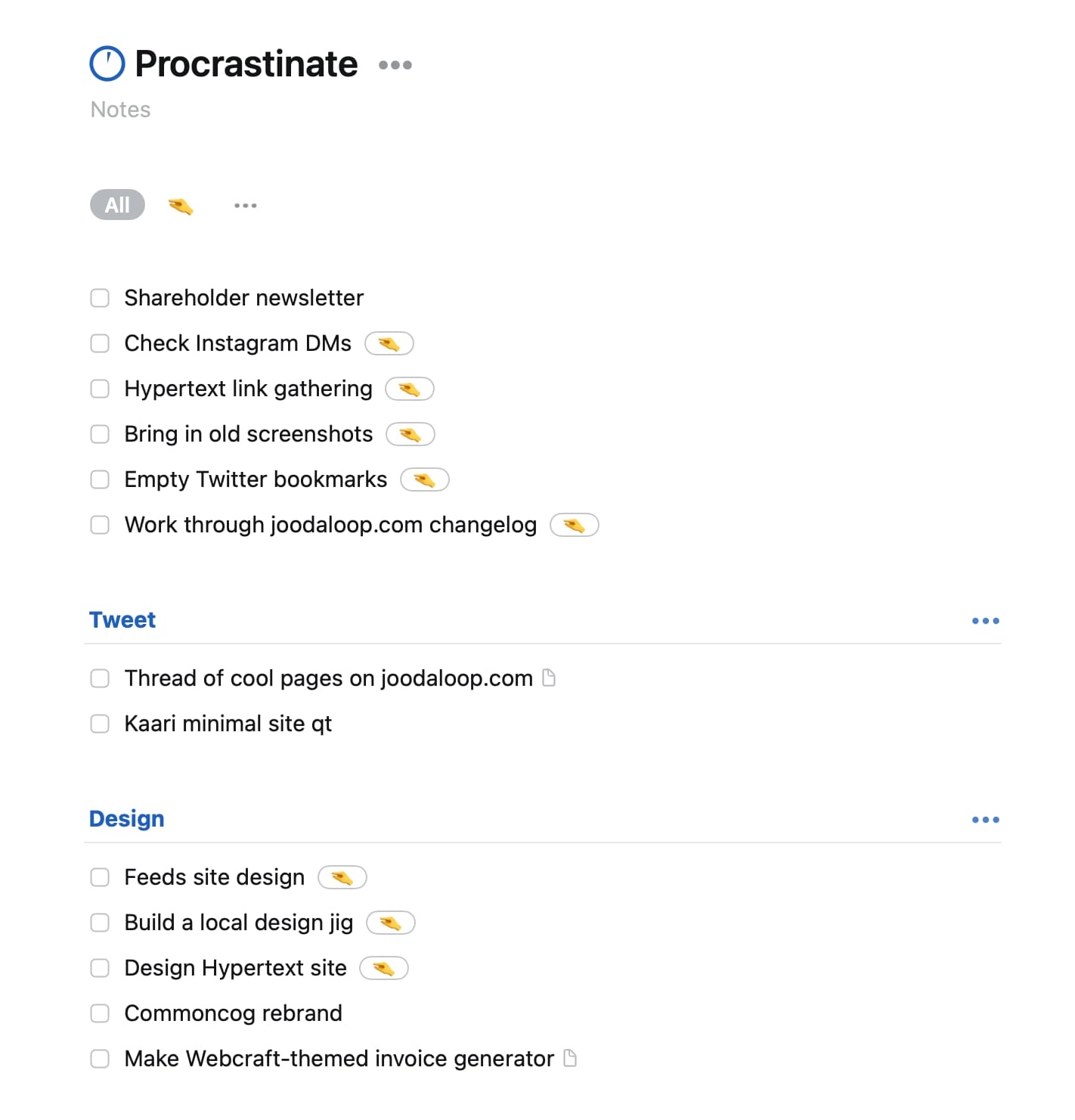
My experience with this system has unearthed a few lessons:
- Do NOT think of it as being productive. The main thing is still the main thing. Don’t lose sight of the fact that anything outside the main thing is, by definition, procrastination. “I am doing nonsense” must be on your mind, even as you pick the best kinds of nonsense to do.
- Ensure it’s finite. The things you pick are meant to spend your restless avoidant energy, so that you can get back to what you were supposed to be doing (ideally with renewed vigour). They can’t do that if they’re bottomless feeds or open-ended projects.
- Don’t let it it lead to wallowing. It is far too easy for a guilty shirking to turn into yet another one. Something about the nature of shame seems to trigger willfull self-destruction. Don’t pick things that leave you feeling regret.
- Optimise for ease. If your chosen activites are too draining, you’ll just procrastinate on them like you did the main thing. Make sure to have a good mix of difficulty and interestingness in your list.
If you feel like commenting on this post, send me an e-mail at judah@joodaloop.com. I check all mail and respond within 2 days.
Info
- Published
- Type
- RIFF